

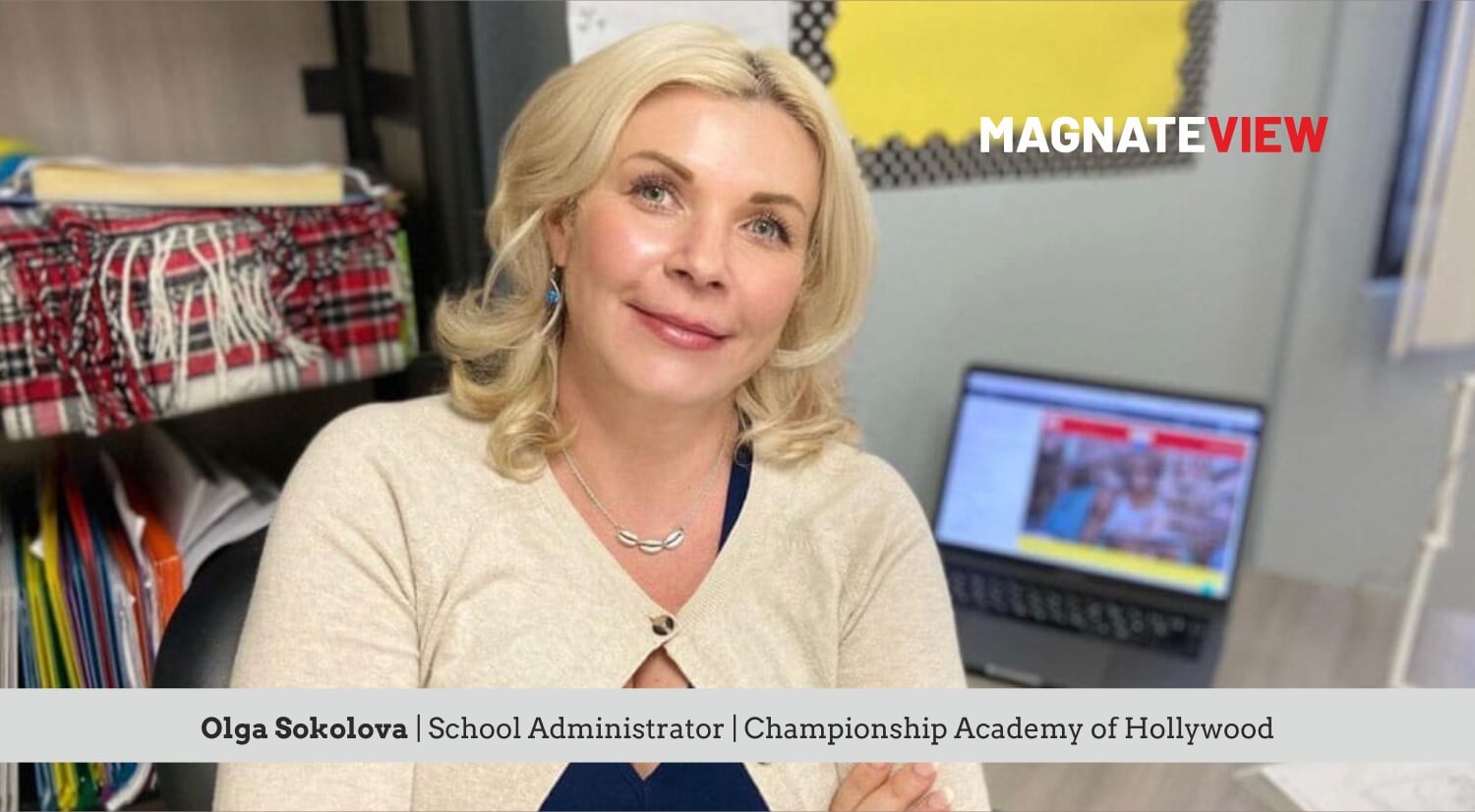

In today’s education system—where classrooms are increasingly shaped by globalization, migration, and technological transformation—the need for leadership that is both structured and human-centered has never been greater.
For Olga Sokolova, School Administrator at Championship Academy of Hollywood, this challenge is not theoretical—it is the foundation of her work.
Through a combination of instructional leadership, applied research, and community-centered practice, Sokolova is helping redefine how schools approach multilingual education, equity, and student success in the United States.
From Classroom Insight to System-Level Impact
Sokolova’s journey began in the classroom, working directly with students navigating language barriers, cultural transitions, and interrupted formal education. That experience shaped what would become her core philosophy: academic success is not limited by student ability—but often by access to the right instructional systems.
Today, she applies that insight at a broader level, designing frameworks that support multilingual learners while maintaining rigorous academic expectations. Her work reflects a shift from isolated interventions to scalable, system-wide solutions that promote both access and achievement.
Addressing a Critical Shift in U.S. Education
Across the United States, the rapid growth of multilingual and immigrant student populations has created both opportunity and urgency.
Sokolova’s leadership directly responds to this shift through:
- Structured ESOL programming
- Data-driven instructional systems
- Targeted support for students with interrupted formal education
She recognizes that modern education must balance accountability with adaptability—ensuring that schools remain inclusive while upholding high academic standards.
Her perspective also reflects broader changes in education over the past decade, including the transition from traditional classrooms to digital learning environments and the renewed focus on social-emotional development following periods of disruption.
Building Scalable Systems for Multilingual Learning
What distinguishes Sokolova’s work is its scalability.
Rather than focusing solely on classroom-level strategies, she has developed systems that can be implemented across schools and adapted to diverse student populations. These include:
- Baseline assessments aligned with language proficiency
- Differentiated instruction models
- Continuous progress monitoring using WIDA ACCESS data
This structured approach ensures that multilingual learners are not separated from academic rigor—but supported in reaching it.
Language as a Gateway, Not a Barrier
Fluent in multiple languages and shaped by her own experiences navigating a new educational system, Sokolova brings both professional expertise and personal insight into language acquisition.
Early in her career, she identified a key instructional gap: overreliance on translated materials limited students’ exposure to academic English. In response, she implemented a structured framework focused on building language proficiency through:
- Vocabulary scaffolding
- Sentence development strategies
- Visual and audio supports
Her approach reflects a growing understanding in education: when taught effectively, language becomes a gateway to opportunity rather than a barrier to success.
From Practice to Publication
Sokolova’s influence extends beyond her school through publications, interviews, and research contributions focused on multilingual education and instructional systems.
Her work explores themes such as:
- The evolution of teaching in diverse classrooms
- The intersection of technology and human-centered learning
- Cultural context in language acquisition
Through these contributions, she emphasizes that effective education must integrate structure with cultural awareness—ensuring that systems are both rigorous and responsive.
Expanding Impact Through Authorship
In 2026, Sokolova expanded her reach with the release of her book, 5 Easy Steps to Learn Spanish.
Designed as a practical and accessible guide, the book introduces a structured methodology that simplifies language learning without reducing its rigor. It reflects her broader philosophy: complex learning processes can be made approachable when supported by clear, intentional systems.
In parallel, she continues developing additional resources aimed at supporting multilingual learners, reinforcing her commitment to accessible and effective language education.
Strengthening School–Community Connections
Beyond instruction, Sokolova has focused extensively on strengthening relationships between schools and families—particularly within immigrant and multilingual communities.
Her initiatives include:
- Multilingual communication systems
- Parent workshops and academic guidance sessions
- Cultural events that promote inclusion and belonging
These efforts address one of the most critical yet often overlooked elements of education: trust.
By making schools more accessible and responsive to families, she helps create environments where students are supported both academically and socially.
Leadership That Balances Structure and Empathy
Sokolova’s leadership style combines high expectations with a strong emphasis on relationships.
Grounded in empathy, cultural understanding, and transparency, her approach creates environments where educators feel supported and empowered. She prioritizes teacher well-being alongside student success, recognizing that sustainable change depends on strong, collaborative teams.
This balance between structure and empathy is increasingly recognized as essential in modern educational leadership.
Measuring Impact Beyond Metrics
While academic performance remains a key priority, Sokolova takes a broader view of success.
Her framework for long-term impact includes:
- Student confidence and engagement
- Language development and academic growth
- Family involvement
- Teacher retention and professional development
This multidimensional perspective reflects a shift in education toward more holistic measures of success—where outcomes extend beyond test scores to include belonging, resilience, and readiness for the future.
A Vision for the Future of Education
Looking ahead, Sokolova sees education entering a period of recalibration—one that requires both reflection and adaptability.
Her guiding principles include:
- Respect for cultural and linguistic diversity
- Reflection through data and continuous improvement
- Adaptation to evolving societal and educational needs
These priorities position her work within a broader effort to build inclusive, resilient, and future-ready education systems.
The Bottom Line
Olga Sokolova represents a modern model of educational leadership—one that operates at the intersection of instruction, systems design, and community impact.
Through her scalable methodologies, commitment to multilingual learners, and focus on inclusive practices, she demonstrates that equity and rigor are not competing priorities—but complementary ones.
At a time when education systems are being asked to do more than ever before, her work offers a clear and compelling message:
Inclusive, structured, and culturally responsive education is not just possible—it is essential.