

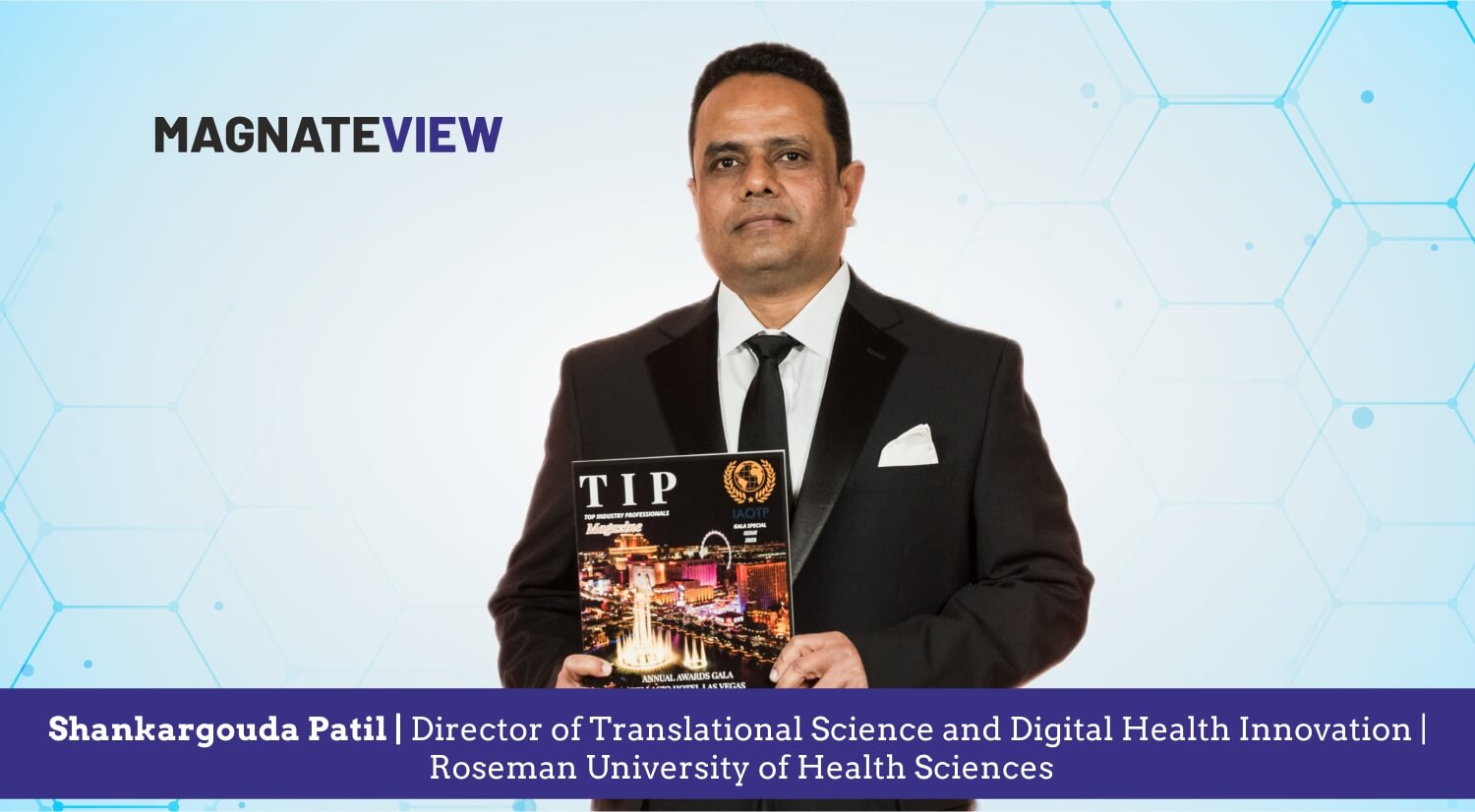

In this interview, we explore the inspiring journey of Shankargouda Patil, Director of Translational Science and Digital Health Innovation at Roseman University of Health Sciences. Join us as he shares his path into healthcare research, defining career moments, leadership philosophy, and the scientific vision driving his work. Discover how translational research, artificial intelligence, and digital health are reshaping modern medicine, how interdisciplinary collaboration fuels innovation, and how he is working to ensure healthcare solutions reach those who need them most. Get ready to gain insight into the future of healthcare through the lens of a scientist dedicated to bridging discovery and real-world impact.
Journey Into Healthcare Research and Translational Medicine
Shankargouda Patil’s journey into healthcare research emerged from a deep curiosity about disease mechanisms and a strong desire to bridge the gap between bench science and bedside care. Early in his career as a dental clinician, he encountered numerous cases of oral potentially malignant disorders that lacked reliable prognostic tools or targeted therapies. This clinical exposure, particularly in underserved regions, led him to question how scientific discoveries could be translated faster and more effectively into real-world healthcare solutions. To pursue answers, he transitioned into oral and maxillofacial pathology and later earned a PhD in medical biotechnology in Italy. This advanced training allowed him to move beyond traditional histopathological diagnosis into molecular oncology, digital pathology, and omics-based stratification. Over time, he recognized translational medicine as the most impactful pathway to integrate clinical observation with cutting-edge science and influence healthcare outcomes at scale. Across academic appointments in India, Saudi Arabia, and the United States, he has built research programs focused on early cancer detection, salivary diagnostics, and digital health innovation. At Roseman University, he now leads initiatives combining artificial intelligence, digital health, and translational research, maintaining a mission to turn complex science into accessible, scalable innovations that transform lives.
Defining Moments That Shaped His Vision
Several pivotal experiences shaped Shankargouda Patil’s vision as a leader in healthcare innovation. One early moment came during clinical training when he treated patients with advanced oral potentially malignant disorders. The realization that many patients slipped through diagnostic and therapeutic gaps motivated him to move beyond clinical practice into translational research focused on molecular and digital diagnostics. His doctoral training in medical biotechnology at the University of Siena marked another turning point, exposing him to molecular biology, omics technologies, and systems thinking. This period reinforced the power of integrative science and cross-disciplinary collaboration. His tenure at Jazan University in Saudi Arabia further strengthened his leadership perspective, where he led diverse research teams and saw how mentoring and collaboration could directly inform clinical practices in resource-limited settings. His current role at Roseman University represents a convergence of these experiences, enabling him to establish sustainability initiatives in dental education and spearhead digital health innovation programs that translate scientific vision into patient-centered applications.
Influences and Mentorship
Throughout his global academic journey, Shankargouda Patil has been shaped by mentors who influenced both his scientific philosophy and leadership approach. During his time at the University of Hong Kong, guidance from Professor Lakshman Samaranayake encouraged him to think beyond disciplinary silos and adopt a systems-level understanding of disease. Thought leaders in digital health and precision medicine, including pioneers working at the intersection of artificial intelligence, genomics, and patient-centered care, have also inspired his evolving vision. At Roseman University of Health Sciences, institutional leaders have provided strong support for academic leadership, research innovation, and institutional service, playing a key role in his professional growth and enabling him to expand translational research initiatives.
Understanding Translational Research in Modern Healthcare
Shankargouda Patil defines translational research as the process of transforming discoveries from laboratories, clinics, or digital platforms into tools that can be applied in real-world healthcare. He views it as a pathway that begins with identifying disease mechanisms and validating biomarkers, then progresses toward building diagnostics, therapeutics, and digital solutions that integrate into everyday practice. In today’s data-driven and patient-centered healthcare environment, translational research must unite biology, engineering, informatics, and clinical sciences while also addressing health systems and patient access. For him, the true value of discovery is realized only when it becomes feasible, scalable, and relevant to patients and providers. Translational research, therefore, is about building bridges that move knowledge from publications into actions that improve outcomes.
Gaps in Traditional Research to Clinic Pathways
His focus on translational science was driven by observed gaps in traditional pathways from research to clinical care. Diagnostic delays and subjectivity in interpretation, particularly in oral pathology, revealed the limitations of conventional methods and the need for artificial intelligence-driven solutions. He also recognized that many research efforts remained theoretical and disconnected from clinical or educational realities, limiting their impact. Fragmentation across disciplines further hindered progress, as siloed work often prevented integrated solutions. These gaps in diagnostic reliability, practical applicability, and collaboration led him to pursue a translational approach centered on interdisciplinary work, clinical relevance, scalability, and educational integration.
Breakthrough Translational Project
A project exemplifying his translational philosophy involved developing a salivary biomarker panel for early detection of oral squamous cell carcinoma and oral potentially malignant disorders. His team identified and validated biomarkers such as IL-8, S100A7, and MMP9, demonstrating strong diagnostic accuracy. The project extended beyond laboratory validation into community-based clinical settings, particularly in underserved populations. By co-developing a portable saliva collection and analysis platform, frontline health workers could perform screenings without specialized infrastructure. This effort improved early detection, reduced referral times, and addressed biopsy delays, turning molecular insights into practical solutions that improved patient outcomes.
Transformative Innovations in Healthcare in 2026
In 2026, he sees the convergence of digital health, artificial intelligence, and molecular diagnostics as the most transformative force in healthcare delivery. Artificial intelligence is now embedded in pathology and radiology workflows, while liquid biopsies and salivary diagnostics are gaining mainstream traction. When integrated through digital health platforms, these tools enable clinicians to combine laboratory data, imaging, and patient-generated information into unified clinical decisions. This integration is shifting healthcare from reactive to predictive, from episodic care to continuous monitoring, and from generalized treatment protocols to precision care.
Convergence of Artificial Intelligence Digital Health and Biotechnology
The convergence of artificial intelligence, digital health platforms, and biotechnology is redefining patient care by enabling predictive and personalized medicine. Artificial intelligence supports rapid interpretation of complex datasets, digital platforms extend intelligence to real-time monitoring and remote diagnostics, and biotechnology provides molecular biomarkers and genomic signatures. Together, these domains create scalable, patient-specific solutions that manage individuals in biological, digital, and behavioral contexts rather than treating diseases in isolation.
Underutilized Innovations With High Impact Potential
Several promising innovations remain underutilized despite their potential. Salivary diagnostics offer non-invasive and cost-effective screening options but are not yet widely integrated into routine care. Artificial intelligence-powered decision support systems often remain confined to academic settings due to regulatory and interoperability challenges. Digital pathology could democratize diagnostic services in low-resource regions but faces infrastructure barriers. Real-world data from electronic health records and wearables remains underleveraged, and clinical genomics has not yet reached frontline care in many disease areas beyond oncology.
Building Effective Cross Domain Partnerships
At Roseman University, Shankargouda Patil fosters partnerships by aligning goals across academia, clinicians, and industry. He emphasizes co-designing research questions, transparency in workflows, and shared responsibility. Multidisciplinary teams are formed early, ensuring projects are both scientifically rigorous and clinically practical. He treats partnerships as long-term ecosystems that promote trust, knowledge exchange, and sustained impact rather than short-term collaborations.
Balancing Innovation With Ethics and Safety
He integrates regulatory, ethical, and patient safety principles from the outset of every project. Structured risk assessment, ongoing monitoring, and stakeholder engagement guide innovation. Rather than viewing regulation as a barrier, he considers it a framework that strengthens trust and accountability while ensuring safe adoption of new diagnostics, therapies, and digital tools.
Leadership Approach in Multidisciplinary Teams
His leadership philosophy centers on alignment rather than control. He creates environments where experts across genomics, artificial intelligence, clinical medicine, and digital technology, understand shared goals and patient impact. Through mentorship, trust, and accountability, he ensures discoveries move efficiently toward meaningful clinical application.
Challenges in Scaling Research Discoveries
Major challenges include bridging the gap between controlled research findings and real-world clinical workflows, ensuring affordability and usability, navigating regulatory landscapes, and building clinician and patient trust. He stresses that innovation must be designed with scalability and implementation in mind from the beginning.
Addressing Funding Infrastructure and Policy Barriers
He addresses these barriers through strategic partnerships, early regulatory engagement, and projects designed for clinical necessity and scalability. By integrating governance, infrastructure, and funding strategies from the outset, his work creates sustainable pathways for innovations to reach practice.
Reaching Underserved and Resource Limited Populations
Inclusivity is embedded into design, not treated as an afterthought. He advocates for context-appropriate solutions such as offline-capable artificial intelligence tools, simplified diagnostics, and leveraging existing community health systems. This approach ensures advanced science translates into accessible care.
Role in Shaping Global Healthcare Innovation
Looking ahead, Shankargouda Patil sees himself as a connector between discovery and delivery, building platforms that move molecular diagnostics, artificial intelligence, and digital health into scalable clinical use. He aims to champion equity-driven innovation and mentor the next generation of translational scientists who work across disciplines and keep patients at the center.
Advice for Early Career Researchers
He encourages early-career researchers to focus on unmet clinical needs rather than technologies alone, embrace interdisciplinary collaboration, and seek mentors who understand both science and systems. Staying patient-centered and implementation-minded, he believes, enables researchers to reshape how science serves society.
In conclusion, Shankargouda Patil’s work reflects a rare blend of scientific depth, clinical insight, and forward-thinking innovation that defines the future of translational healthcare. By bridging molecular research, artificial intelligence, and digital health with real-world clinical needs, he exemplifies how modern science can move beyond discovery into meaningful, scalable impact. His leadership across disciplines, commitment to ethical and inclusive innovation, and focus on accessibility for underserved populations position him not only as a researcher, but as a global connector between ideas and implementation. As healthcare continues to evolve toward precision, prediction, and patient-centered models, his journey underscores a powerful message: the true measure of innovation lies in how effectively it improves lives.