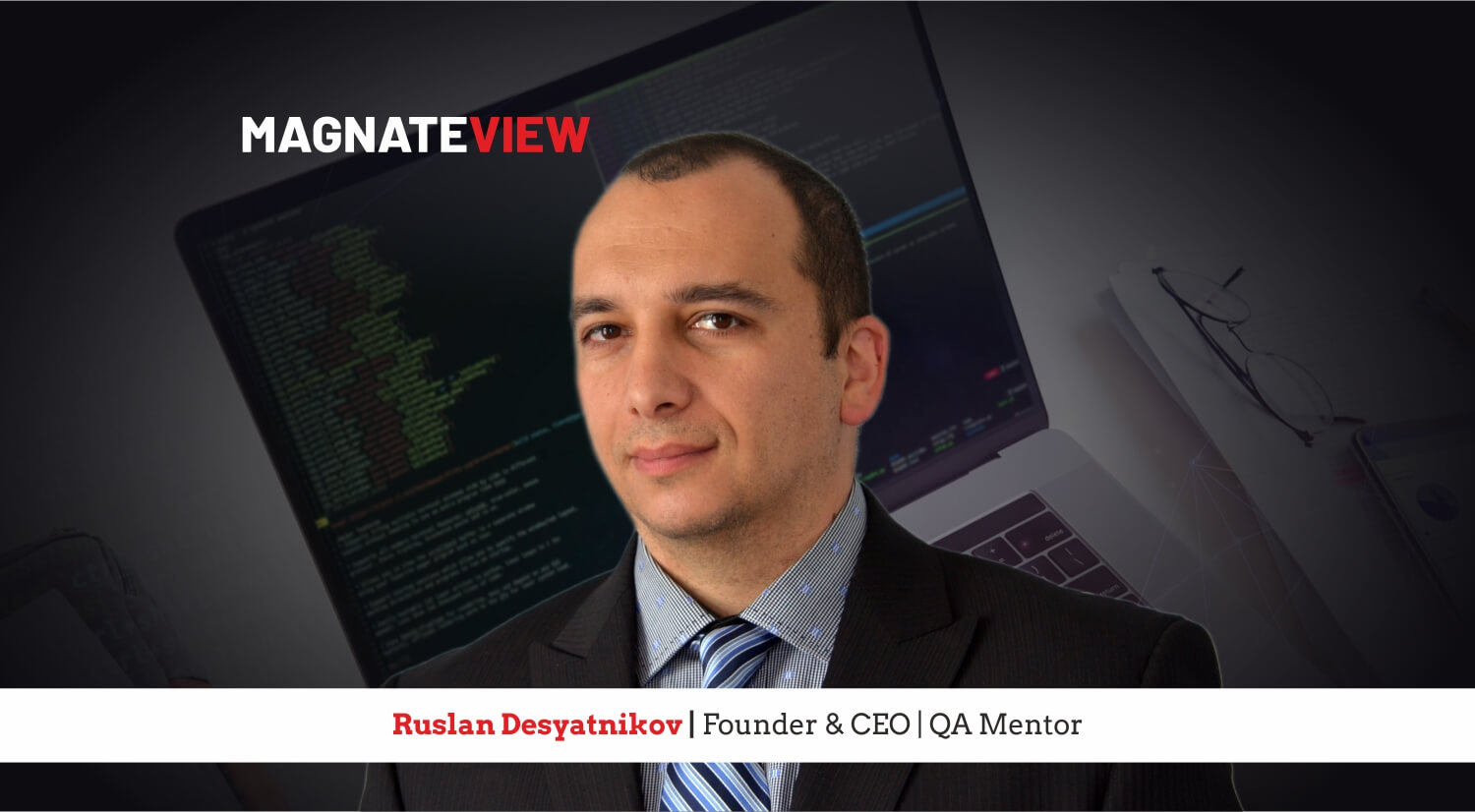
In this interview, we delve into the remarkable story of how Ruslan Desyatnikov, the Founder and CEO of QA Mentor, embarked on his path to success in the field of software testing. Join us as Ruslan shares his experiences, innovative contributions, leadership insights, and the values that continue to shape his vision. Discover what sets QA Mentor apart, how Ruslan integrates human intelligence with technological advancement, and his perspective on the evolution of software testing in the age of AI. Prepare to be inspired by Ruslan’s relentless pursuit of excellence and his commitment to transforming the quality assurance landscape.
Early Journey into Software Testing
Ruslan Desyatnikov began his journey in the software testing industry 27 years ago, shortly after graduating from Baruch College with a bachelor’s degree in Computer Information Technology. Initially facing difficulties in securing a job, he eventually accepted a junior tester position that offered minimal pay. Despite his limited understanding of quality assurance at the time, Ruslan quickly developed a strong interest in the field. The process of identifying problems and helping to improve product maturity captivated him. Over time, he progressed through various companies, taking on increasingly senior roles. He held significant QA management positions, leading testing centers of excellence in financial institutions and overseeing testing cycles involving over 150 testers globally, managing teams spread across multiple geographies. This expansive experience eventually led to the founding of QA Mentor 14 years ago. QA Mentor specializes in all aspects of quality assurance and software testing, providing global organizations with the expertise to enhance product quality, security, performance, and reliability.
The Drive to Revolutionize Software Testing
What inspired Ruslan to focus on revolutionizing software testing was his lifelong advocacy for quality and disciplined methodologies. Quality assurance, to him, represents a transformative process — taking unstable, issue-ridden code and evolving it into mature, high-quality applications capable of generating significant value for users and businesses. His mission has been to help clients build products that users can rely on and derive real benefits from, whether in their personal lives or business operations. Ruslan finds motivation in ensuring users remain engaged with their chosen platforms rather than turning to competitors, and in his pursuit to create software that is genuinely useful, robust, and satisfying for end users.
Innovations Driving the Future of Testing
QA Mentor is at the forefront of numerous innovations in the software testing industry. Ruslan emphasizes the significance of smart automation — a principle that responds to client demands for faster, more stable testing processes. With manual testing alone proving insufficient for today’s accelerated development cycles, QA Mentor has integrated automation and AI technologies to enhance efficiency. The company leverages enterprise-level tools, open-source technologies, and proprietary solutions such as QA Coverage — a comprehensive test management platform that tracks the entire software development lifecycle with key performance indicators and metrics. Additionally, Ruslan promotes human intelligence testing strategies that focus on risk-based and impact analysis approaches. These methodologies allow testers to predict and prevent potential issues more effectively, using their insight to complement automated systems.
Development of Proprietary Tools and Frameworks
Ruslan and his team have developed a suite of groundbreaking methodologies and frameworks tailored to different testing disciplines. QA Mentor currently offers seven distinct QA methodologies, including those for automation, performance, security, risk-based testing, regression, and compatibility. These methodologies are the result of years of development and refinement and are publicly accessible on the company’s website. The frameworks developed by QA Mentor utilize technologies such as Selenium, Java, Python, and various enterprise-level tools like Ranorex and TestComplete. One of the most notable tools is QA Coverage, which supports test case creation, defect tracking, and test execution — all within a unified platform. This combination of proprietary tools and customized methodologies empowers QA Mentor to deliver unmatched value to its clients and maintain a competitive edge in the market.
The Role of AI and Machine Learning in Testing
In Ruslan’s view, AI and machine learning are fundamentally reshaping the software testing industry. Over the past three years, QA Mentor has witnessed a growing demand for smart automation and AI-powered tools. To stay ahead, the company maintains a dedicated research and development department that evaluates new AI tools through trials and proof-of-concept implementations. Although many AI tools show promise, Ruslan acknowledges that they are not yet fully mature. While AI can accelerate test execution and generation, it lacks the contextual understanding and judgment that human testers provide. QA Mentor integrates AI tools into its processes to boost productivity, but always with human oversight — ensuring results are reviewed and validated. Ruslan predicts that AI will become a critical enabler in the industry, but only when combined with human intelligence will it truly drive transformative change.
Challenges of AI-Driven Test Automation
One of the biggest challenges Ruslan identifies with AI-driven test automation is trust. AI, while fast and efficient, does not comprehend the nuances of business logic or user behavior. This can lead to missed scenarios or flawed test coverage. QA Mentor addresses this by ensuring experienced testers review AI-generated outputs. Another issue is maintenance — AI-generated tests often become outdated with frequent product updates. To counter this, QA Mentor employs tight feedback loops, continuously updating and retraining AI models. Ruslan also notes a lack of transparency in how AI tools make decisions, which can be problematic when accountability is required. For this reason, the company selects tools carefully and maintains clear audit trails. Ultimately, while AI acts as a powerful assistant, critical thinking and judgment remain squarely in the hands of human testers.
The Enduring Importance of Human Testers
Ruslan firmly believes that human testers will continue to play a vital role in the years ahead. Automation may handle repetitive tasks, but it cannot replicate the critical thinking, empathy, and user-centric mindset that human testers bring. This belief is the foundation of his Human Intelligence Software Testing (HIST) philosophy. HIST emphasizes qualities like creativity, judgment, and intuition — aspects that machines cannot replace. According to Ruslan, testers of the future must be strategic thinkers capable of guiding automation efforts and interpreting AI results. Rather than being replaced by machines, skilled testers will become more valuable, especially those who understand how to merge technology with human insight.
Emerging Trends That Will Define the Next Five Years
Looking ahead, Ruslan sees several major trends shaping the future of software testing. AI and automation will continue to grow, but without strong human direction, their impact will be limited. Movements like HIST will bring critical thinking back to the forefront, ensuring that testing is more than just automated execution. Quality will increasingly become a shared responsibility across development, product, and business teams — not just QA. Testers will evolve into analysts, strategists, and advocates for users. Those who can think beyond tools and scripts will lead the next wave of innovation in software testing.
Testing in the Era of Low-Code/No-Code Development
Low-code and no-code platforms are transforming how applications are built, but they introduce new complexities for testing. Ruslan points out that while these platforms accelerate development, they often obscure the underlying risks. As non-technical users build applications through visual interfaces, integration issues and logical flaws can easily go unnoticed. This environment demands smarter, more thoughtful testing. HIST becomes especially relevant here, as testers must focus on business process validation, risk analysis, and close collaboration with developers and product stakeholders. The testing landscape is evolving to require deeper thinking and greater involvement from testers throughout the development lifecycle.
Advice for Companies Looking to Lead in Testing Innovation
For companies aiming to stay ahead in testing innovation, Ruslan advises a balanced approach that combines cutting-edge technology with human intelligence. Investing in automation and AI is crucial, but these tools must be guided by skilled professionals who understand the broader context. Companies should foster a culture where quality is a shared responsibility, supported by methodologies like HIST that emphasize critical thinking and strategic insight. By blending the power of AI with human creativity and judgment, organizations can elevate their testing practices and lead the way in delivering high-quality, user-centric software.
In conclusion, Ruslan Desyatnikov’s journey exemplifies the power of resilience, innovation, and unwavering commitment to excellence. From his early beginnings to founding QA Mentor and navigating the evolving landscape of quality assurance, his story is one of continuous learning and purposeful leadership. His insights serve as an inspiration for aspiring professionals and entrepreneurs, highlighting that true success is built not just on achievements, but on the values and vision that guide each step forward.