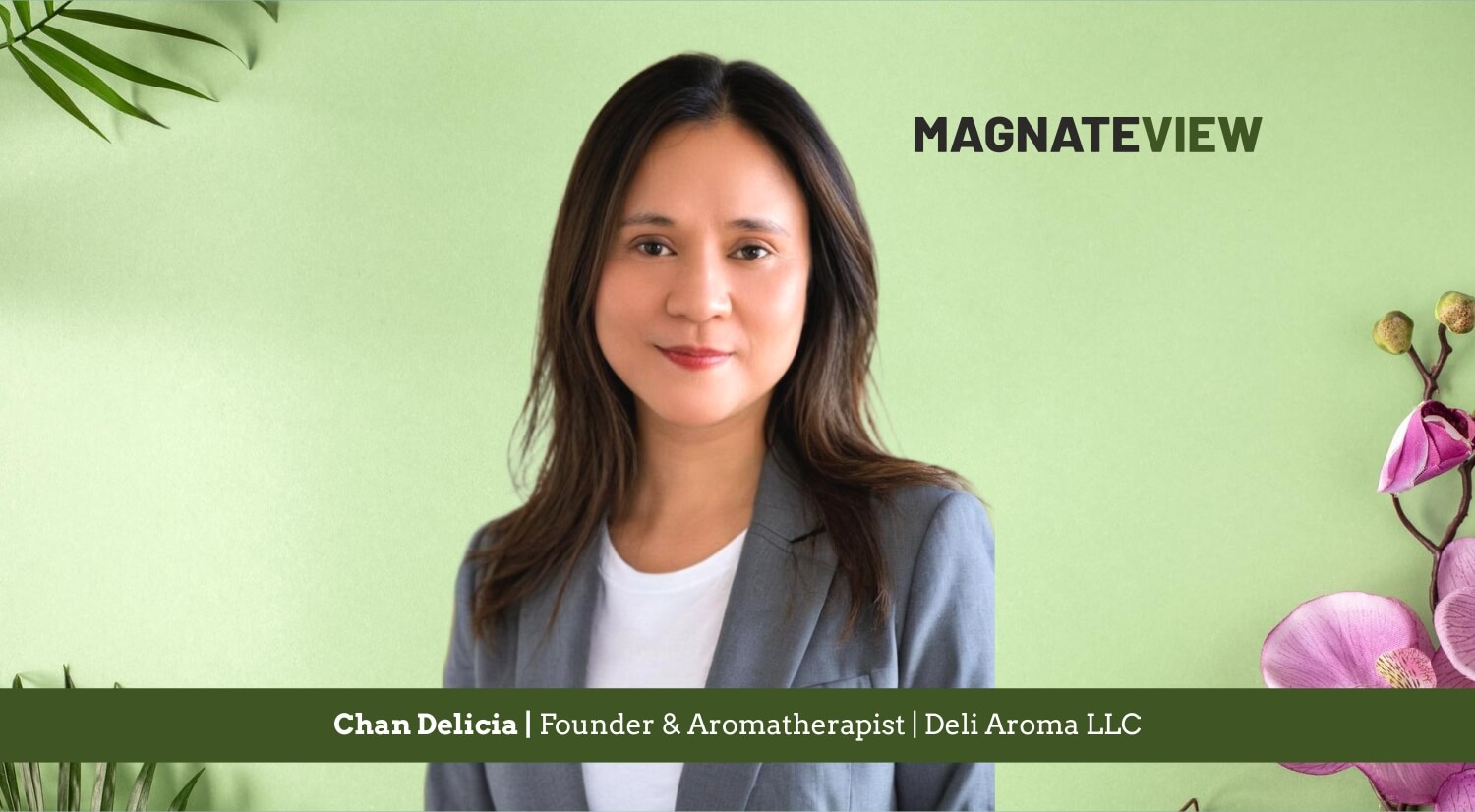
In this interview, we delve into the remarkable story of how Chan Delicia, the Founder and Aromatherapist of Deli Aroma LLC, embarked on her path to healing and wellness. Join us as she shares her personal journey, groundbreaking insights, professional challenges, and the philosophies that have guided her work. Discover how Chan’s unique approach bridges science and holistic practices, how she overcame personal struggles to shape her vision, and what she hopes to contribute to the global wellness movement in the years ahead. Get ready to be inspired by her resilience, determination, and the scientific curiosity that continues to fuel her practice.
Early Signs of a Life in Healing and Wellness
Chan Delicia was born prematurely in the seventh month of her mother’s pregnancy, which left her vulnerable to frequent illness and hospital visits well into her forties. Frustrated by the lack of progress in treating chronic issues such as acne, she began reading extensively about Traditional Chinese Medicine, which was very popular in Hong Kong at the time. Unlike casual readers, she immersed herself fully, revisiting texts until she could not only remember the material but also understand the reasoning behind conclusions. This early discipline, combined with her determination to uncover answers for herself, laid the foundation for her future path in healing.
A Formative Turning Point Through Personal Adversity
One of the most significant adversities Chan faced was struggling with acne for over 30 years. Neither conventional medicine nor natural remedies—including Traditional Chinese Medicine—brought relief. She realized that the treatments were failing because they were based on flawed fundamentals. Through her own research, she discovered that the acne was actually an outward expression of inflammation in her brain. Once she began addressing her brain’s overactivity with the right medicines, her acne began to clear. Later, her research on mitochondrial health led her to suspect that inflammation in the mitochondria also played a role. Her personal suffering thus became the driving force behind her lifelong mission in wellness.
The Evolving Meaning of Wellness
For Chan, wellness has never been a static concept but one that has evolved alongside life experiences and scientific discoveries. In childhood, wellness meant eating nutritious food, particularly vegetables. In adulthood, it expanded to include supplements like collagen and vitamins. Her time in the United States emphasized exercise and clean eating, later evolving to focus on high-quality oils such as Omega-3 for disease prevention. Over the years, social and scientific influences—including concerns over microplastics—shaped her understanding of wellness. Today, she sees it as encompassing both physical and mental health, influenced by constant research, trends, and cultural shifts.
Balancing Intuition with Science
In Chan’s view, intuition plays a controversial role in healing. While it is celebrated in art, in science and medicine it can be dismissed as irrational. However, she believes that insight and perception are crucial for innovation. Just as Einstein’s theory of relativity was born from intuitive thought, Chan sees intuition as the spark that allows scientific breakthroughs to flourish when combined with rigorous research and logical reasoning.
The Profound Influence of Mathematics
Mathematics has been the most influential scientific discipline shaping Chan’s methods. With parents who majored in mathematics, she inherited a logical and structured way of thinking. She is drawn to simplification, algebraic reasoning, and logical deductions, which she incorporates into her healing philosophy. This mathematical lens helps her distill complex ideas into clear, actionable methods for wellness.
A Research Discovery That Changed Client Care
Chan revolutionized the traditional use of rubefacients, which are substances that create redness to improve blood circulation. Conventional methods often rely on irritants like hot pads, which can harm the skin. Through her innovative approach, she uses essential oil blends with gentle Gua Sha techniques to achieve results without irritation. By recognizing that essential oils can penetrate deeply on their own, she demonstrated that gentleness could be both safer and more effective than aggressive traditional methods.
Facing Skepticism in Holistic Circles
Introducing science-based techniques into holistic circles is not without resistance. Chan acknowledges that traditionalists and those with vested interests often oppose innovation. Her strategy is to introduce new ideas gradually, first presenting them with evidence-based credibility before advancing to more fundamental changes. This careful approach allows her to balance respect for tradition with the pursuit of progress.
Helping Clients Overcome Emotional Blockages
Chan notes that many clients are reluctant to reveal the full truth about their struggles, sometimes hiding information or presenting inaccurate stories. As a result, therapists must rely heavily on experience and knowledge, while diplomatically navigating incomplete information. She stresses the importance of approaching clients with care and patience, always hoping they will eventually share their truths.
A Scientific Approach Without Spiritual Boundaries
Chan does not confine her work to any specific spiritual discipline or belief. Instead, she remains open to diverse perspectives while grounded in scientific fundamentals. For her, truth in healing comes from evidence and reason, not from spiritual frameworks.
A Challenging Yet Transformative Decision
Recently, Chan encountered a client who faced severe joint issues from years of poor posture while working. Although her formulations provided some relief, the client ultimately required surgery. This experience reminded Chan that without adequate rest, no formulation or therapy could achieve true healing. Another client with a similar condition found success after incorporating more rest into her routine. These cases reinforced Chan’s conviction that rest is an essential, often overlooked, element of recovery.
Building Trust With Clients
In today’s world, Chan observes that networking often plays a greater role than treatment quality in attracting clients. Building trust, she believes, takes time, patience, and consistent results. Since healing can be a slow process, therapists must steadily earn confidence through commitment and care.
Stories of Transformation
While respecting client privacy, Chan highlights that the most surprising transformations often come from those who diligently continue their self-care practices outside of sessions. These individuals reinforce her belief that healing is a partnership between therapist and client, with success depending on effort from both sides.
The Global Wellness Conversation in 2025
Chan sees a significant shift in how people approach wellness today compared to five years ago. Self-care has become more popular, with individuals relying less on medical professionals except in urgent cases. While this trend empowers people, it also introduces risks, as not all self-care practices are based on accurate knowledge. The growing integration of diverse healing methods has made the wellness landscape both richer and more complex.
Cultural Inspirations for Healing
Growing up in Hong Kong, where Traditional Chinese Medicine was widespread, Chan has long drawn inspiration from its 5,000-year-old history. She also incorporates Newton’s third law of motion into her philosophy, believing that often “less is more” in the healing process.
Vision for Legacy
Chan views her work as an extension of her predecessors, building upon existing foundations while offering fresh perspectives. Though she humbly regards her contributions as common sense, others see her innovations as a valuable legacy for future practitioners. She hopes her work will be remembered as part of a larger collective effort to advance the field of wellness.
Correcting Misunderstandings About Healing
Chan believes that one of the greatest misunderstandings about healing is the assumption that progress is always straightforward. Her recent explorations into Alzheimer’s, dementia, and Parkinson’s disease revealed how easily researchers can lose clarity when delving too deeply into complexities. She emphasizes the importance of stepping back to maintain perspective, reminding practitioners not to get lost in excessive detail.
A Vision for the Next Five Years
Looking ahead, Chan aims to publish research papers on diabetes, rheumatoid arthritis, and neurological conditions such as Alzheimer’s, dementia, and Parkinson’s. She plans to revisit past work with fresh insights, sometimes advocating for simplification rather than complication. Her forward-looking vision is to continue advancing the science of healing while reinforcing the principle that sometimes, less truly is more.
In conclusion, Chan Delicia’s story is one of resilience, curiosity, and transformation. From a childhood marked by fragile health to a career defined by scientific discovery and innovative healing, she has never stopped seeking answers to life’s most complex wellness challenges. Her ability to bridge science and holistic practices, while remaining grounded in logic and compassion, sets her apart as a true pioneer. As she looks to the future, Chan remains dedicated to advancing her research, sharing her insights, and inspiring both practitioners and clients to embrace wellness in its truest, most integrative form.